
For almost four years now, we’ve been told that AI will make us more productive. For once, the promise isn’t completely hollow: the time saved is very real. What’s missing is the rest of the sentence. Time saved… for whom?
I’ll go back in time a little, to the industrial era, or rather to that period when factory work was the norm. Then I’ll look at where productivity gains are going today, before suggesting a few fairer options. The lens is necessarily mine: that of someone who spends his days studying AI tools to put them at the service of others, and who wonders who is actually benefiting from our productivity gains.
Contents
Back to the factory • The industrial era
In the industrial era, the deal was simple. Want to earn more? You’d work a second eight-hour shift. Sixteen hours at the factory brought the company much more than eight, and part of it ended up on your paycheck. Logical, simple, effective.
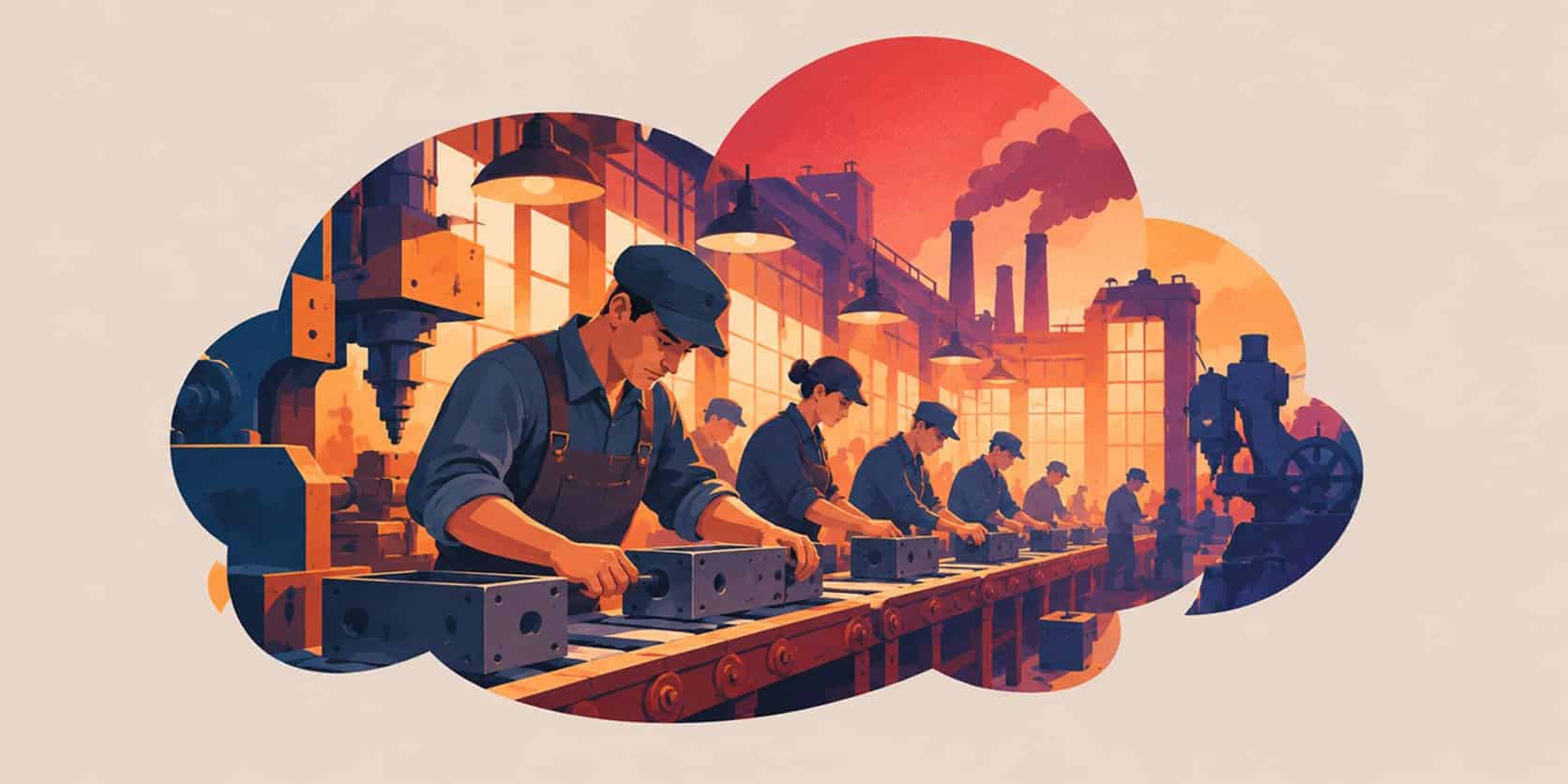
This deal came at an enormous human cost. In France, before the law of April 23, 1919, working days often lasted 10 to 12 hours. The eight-hour day was a long-standing workers’ demand, championed by unions and several bills (in French). Today, European law caps the working week at 48 hours on average, overtime included.
Good. But as a result, the “work more” lever got stuck.
Work more to earn more
Nicolas Sarkozy did try to reopen it. In October 2006, he coined the slogan “Travailler plus pour gagner plus” (“Work more to earn more”), and the TEPA law of August 21, 2007 encouraged overtime. Four years later, two members of the French Parliament, one from the majority and one from the opposition, assessed its results for the National Assembly.
The “earn more” part did happen: more than nine million employees benefited, with an average gain of about €500 a year. The “work more” part, however, is nowhere to be found: the number of overtime hours did not increase significantly. Cost of the operation: more than €4.5 billion.
Strange.
From the factory to the service sector
Meanwhile, our jobs have changed in nature. In the European Union, industry’s share of employment fell from 20.7% in 1996 to 15.3% in 2016. Nearly half of all jobs are now concentrated in two major groups of service activities.
So in a service job, what is an hour worth?
Take a plumber. Yesterday, it took him an hour to unclog your sink. Today, with a better tool, he does it in twenty minutes. Yet no one would suggest you pay only a third of the bill, because what you’re paying for is the result.
Office work runs the other way around. We pay for seven or eight hours of presence, and pretend it measures the value produced.
An hour no longer says anything specific. And no matter what you do during that hour, the paycheck “lands” at the end of the month.
Let’s look at the curve
This disconnect between time, value and pay didn’t start with ChatGPT. In the United States, the Economic Policy Institute (EPI) has long compared productivity with the pay of “typical” workers. Between late 1979 and mid-2026, productivity grew by 93.7% and hourly compensation by 32.7%.
Almost three times faster, then.

You’ll tell me these are American figures. And you’d be right. Except that the OECD has observed the same phenomenon in most of its member countries: raising productivity is no longer enough to raise the typical worker’s real wage. (Yes, the report dates from 2017. I doubt the trend has miraculously reversed since then, but I’ll let you check.)
The most ironic part? In 1930, John Maynard Keynes imagined that a century later, a fifteen-hour week would be enough. His idea in a nutshell? If we want to keep as many people as possible in work while creating value for everyone, rising productivity per person would let us easily cut working time by 60%.
We are infinitely richer than in 1930. The fifteen hours, on the other hand…
Incidentally, his horizon was 2030. We have four years left to prove the man right 😉
Right, now add AI to that curve.
Let’s look for the time saved
Let’s start with the good news: time savings aren’t a sales pitch. According to a survey by the European Central Bank (ECB), the share of euro area employees using AI at work rose from 26% in 2024 to 52% in 2026. The median user reports saving three hours a week, about 7.7% of their working time.
Three hours. Almost half a day. So where did those hours go?
Where do those hours go?
A Danish study gives a fairly clear answer. It combines surveys of 25,000 people with the country’s administrative records. The result: 85% of chatbot users reallocate the time saved to other tasks. Fewer than 10% use it to take more breaks or enjoy more free time.
And what about pay? Two years after ChatGPT arrived, the researchers, Anders Humlum and Emilie Vestergaard, find no effect on earnings or on reported hours, including among daily users. In fact, 97.7% of users themselves say it has changed nothing on their paycheck.
Where does the money go?
The time saved hasn’t disappeared. It has just changed pockets 😉
And it’s not me saying this, it’s… OpenAI. In a public policy document published in April 2026, the company acknowledges that people can recognize a productivity gain without feeling they see the benefits. When the company selling the tool writes it in black and white, I think the question deserves to be asked out loud. (Still, keep in mind that OpenAI has every interest in appearing responsible on this topic.)
So I’ll ask it. Are you better paid since you started using AI, with what you’d consider a direct, logical link? Have you been given a day off, a bonus, any perk at all?
A personal note: my professional circle has always rated me as more productive than average. I sincerely thank them for that. But looking back, I know three things:
- it isn’t necessarily rewarded, or even useful, in a company. Maybe I’m a bit foolish to keep at it;
- it won’t get any better with AI;
- what can’t be measured can’t be negotiated.
That third point is the heart of the problem. “What can’t be measured can’t be negotiated.” And when a difference can’t be negotiated, it ends up as silent discrimination: same salary, not the same contribution, and no clean way to talk about it without coming across as arrogant.
AI only amplifies this unease. It potentially helps all of us go faster on low-value tasks. Some people will save 10% of their time, others will multiply their output by 2 or 3. In the end, we’ll still be paid for 35 to 40 hours a week.
The profit, meanwhile, flows to the company.
Let’s be wary of perceived productivity
Before claiming our share, a bit of humility all the same. The productivity we feel isn’t necessarily the productivity we produce.
In 2025, the METR organization ran a randomized trial with 16 experienced developers on 246 real tasks. With AI, they took 19% longer. The most troubling part? Afterwards, they believed they had been 20% faster.
Ouch. Quite a gap. Quite a perception bias.
Important note: METR has since relaunched the experiment, but considers its new data unreliable. Too many people now refuse to work without AI in order to take part. This result therefore mostly reflects a moment in time, and a significant perception bias. And the fact that this second randomized trial was undermined by changing work habits is far more revealing.
Another nuance, this time in customer support. A study of more than 5,000 agents measures an average gain of 15%, with large differences from one person to the next. The least experienced improve markedly, the most experienced barely at all. The ECB also observes a highly skewed distribution: most gain a little, a few gain enormously.
Within a company, I roughly see two families of use:
- Timid uses: getting a text proofread, generating slides, rephrasing an email.
- Bold uses: challenging the status quo, building interfaces, internal tools, automations.
The gains are worlds apart. They are no more equitable than our differences in skills or motivation.
See the trap? If you reward individuals, you reward perception, already-advantaged profiles, and those who know how to sell themselves. Measure the overall gain first, at team or company level. Then look at individual differences, to understand them rather than to rank people.
Let’s refuse to let the gain become a faster pace
Now, it’s worth noting that some companies have already decided what to do with the time saved.
Example or counter-example?
In April 2025, Shopify’s CEO published an internal memo stating that reflexive AI use was becoming a baseline expectation. With a rule that got people talking: before asking for more headcount, teams must demonstrate why AI can’t do the job. Do we really need to go that far? I don’t think so.
At Klarna, a February 2024 press release claimed that its AI assistant was already doing the equivalent work of 700 full-time agents. That’s what the company says about itself, and the rest of the story seems more nuanced than the press release, with a U-turn in 2025. A personal note: I had to use one of Klarna’s services in 2024, and I can assure you it was a disaster in many ways. Their 2025 U-turn doesn’t surprise me.
Real gain or illusion?
Congratulations, you saved two hours thanks to AI. Your reward? Two more hours of work, and a higher target next year. As you’ll have gathered, I’m being sarcastic here. Well… truth be told, only barely.
The Danish study confirms it in its own way: 12% of chatbot users report new workloads, even without any initiative from their employer. And even OpenAI recommends limiting AI uses that intensify workloads.
In the companies I work with, I have the impression of seeing a double movement. Those who have adopted AI end up with ever more on their plate. Those who refuse it feel they’re being gently sidelined, or fear it will happen eventually.
This is a personal observation, not a statistic. In Denmark, the data show no effect on the employment of people who don’t use these tools. Maybe it’s my bubble. Maybe it’s too early to generalize.
I’ll say it anyway: “a gain that isn’t shared is just a faster pace, always for the same people.”
Let’s share the dividend
OK, enough grumbling. There are options, some already tested, some still experimental. Here are the ones I find most interesting.

Let’s give time back, at equal pay
The first: keep everyone employed and reduce working time without cutting pay, in proportion to the gain AI brings the company.
Utopian? Not as much as you’d think.
In the United Kingdom, 61 companies and around 2,900 employees tested the four-day week in 2022, with pay maintained. At the end of the trial, 56 of them were continuing, or 92%. A year later, at least 54 were still applying it, 31 of them permanently. This pilot had nothing to do with AI. But AI makes the argument even easier to defend, I think.
In June 2025, Roger Kirkness, CEO of the startup Convictional, moved to a four-day week with no pay cut for his 12 employees, citing AI gains. His argument, in a nutshell: nothing that now matters in the work correlates with hours. And I find it a good summary of the complete disconnect between increased productivity and purchasing power. (The malaise of our century.)
OpenAI also proposes pilots of 32 hours with no loss of pay, where the recovered hours would become a shorter week or time off. In the United States, a bill goes in the same direction. Sociologist Juliet Schor estimates that AI gains could allow 35 million people to move to a 32-hour week within ten years. (source)
Let’s offer a four-day week to those who want it
A more flexible variant: offer an 80% schedule paid at 100% to people whose productivity has clearly increased.
I can see the risk of unfairness coming a mile off. Hence the importance of measuring the gain at team level before attributing it to anyone.
Let’s raise pay, or share the profits
Second lever: money. Salaries can be raised based on productivity gains, or a bonus indexed to results can be paid. OpenAI also suggests bonuses tied to measured productivity gains.
In Luxembourg, the tool already exists: the profit-sharing bonus, or “prime participative” (in French), 50% tax-exempt under certain conditions. Since 2025, a company can devote up to 7.5% of its profit to it, capped at 30% of annual salary. In 2025, 2,066 companies used it, for 43,404 employees. (Source: Paperjam, in French)
What if part of that budget were explicitly indexed to AI-related gains?
Let’s leave people the choice to change nothing
Not everyone wants to spend their days with AI. It’s a respectable choice, whether economic, ecological or political.
In the ECB survey, 41% of respondents say they are simply not interested in these tools. Penalizing that choice would turn a tool into a condition of employment.
A few more ideas for the road
- Bankable hours. Convert the time saved into leave to take freely, rather than a fixed shorter week.
- Hiring rather than intensifying. The report on the TEPA law already suggested making hiring easier. I think the reasoning applies perfectly to AI.
- A voice for teams. Involve employees in decisions about deploying AI. For Eurofound, efficiency gains must go hand in hand with better job quality and suitable working arrangements.
- Training and mobility. In Denmark, people who use AI and change occupations see their earnings grow 12 points faster than others.
You’ll point out that the company pays for the licenses, training and integration, and that it’s only normal for it to recoup the gain. And you might be right, in part: reported benefits are higher when the employer encourages and invests. But between “a part” and “all of it”, there’s a margin, a big margin. Besides, an investment pays for itself over time.
So, what’s the conclusion?
I don’t believe AI broke the “work more to earn more” deal. Above all, it made visible that the deal had stopped holding up long ago. Our wages decoupled from productivity well before AI came along.
What’s changing is the scale. Three hours a week, for half of the euro area’s employees, adds up to quite a sum. Someone is pocketing that sum.
So, in your company, where did your three hours go? And if you’re a manager or business leader, what are you going to do with them?
I’m genuinely curious to hear your feedback, whether you agree with me or not. Come and discuss it on social media, that’s where these reflections really come to life.
And don’t forget: stay critical 🙂
Further sources and resources
- “Évaluer le travailler plus pour gagner plus”, report by Jean-Pierre Gorges and Jean Mallot, French National Assembly (2011, in French)
- “The Productivity–Pay Gap”, Economic Policy Institute
- “Decoupling of wages from productivity”, Cyrille Schwellnus, Andreas Kappeler and Pierre-Alain Pionnier, OECD (2017)
- “AI adoption and the productivity promise”, António Dias da Silva, Laura Lebastard and David Sondermann, ECB (2026)
- “Still Waters, Rapid Currents”, Anders Humlum and Emilie Vestergaard, NBER (2026)
- “Measuring the Impact of Early-2025 AI on Experienced Open-Source Developer Productivity”, Joel Becker, Nate Rush, Elizabeth Barnes and David Rein, METR (2025)
- “Generative AI at Work”, Erik Brynjolfsson, Danielle Li and Lindsey Raymond (2025)
- “The results are in: the UK’s four-day week pilot”, Autonomy (2023)
- “Industrial Policy for the Intelligence Age”, OpenAI (2026)
- “Economic Possibilities for our Grandchildren”, John Maynard Keynes (1930)
Images generated with AI based on an original creation.
Post a comment for this article?
Follow comments and trackbacks